Not a showroom.
Three workstreams.
The lab does three things: stabilise the diaphragm process, get the magnetic topology right, and calibrate finished units for production. Below are the real parameters from each line.
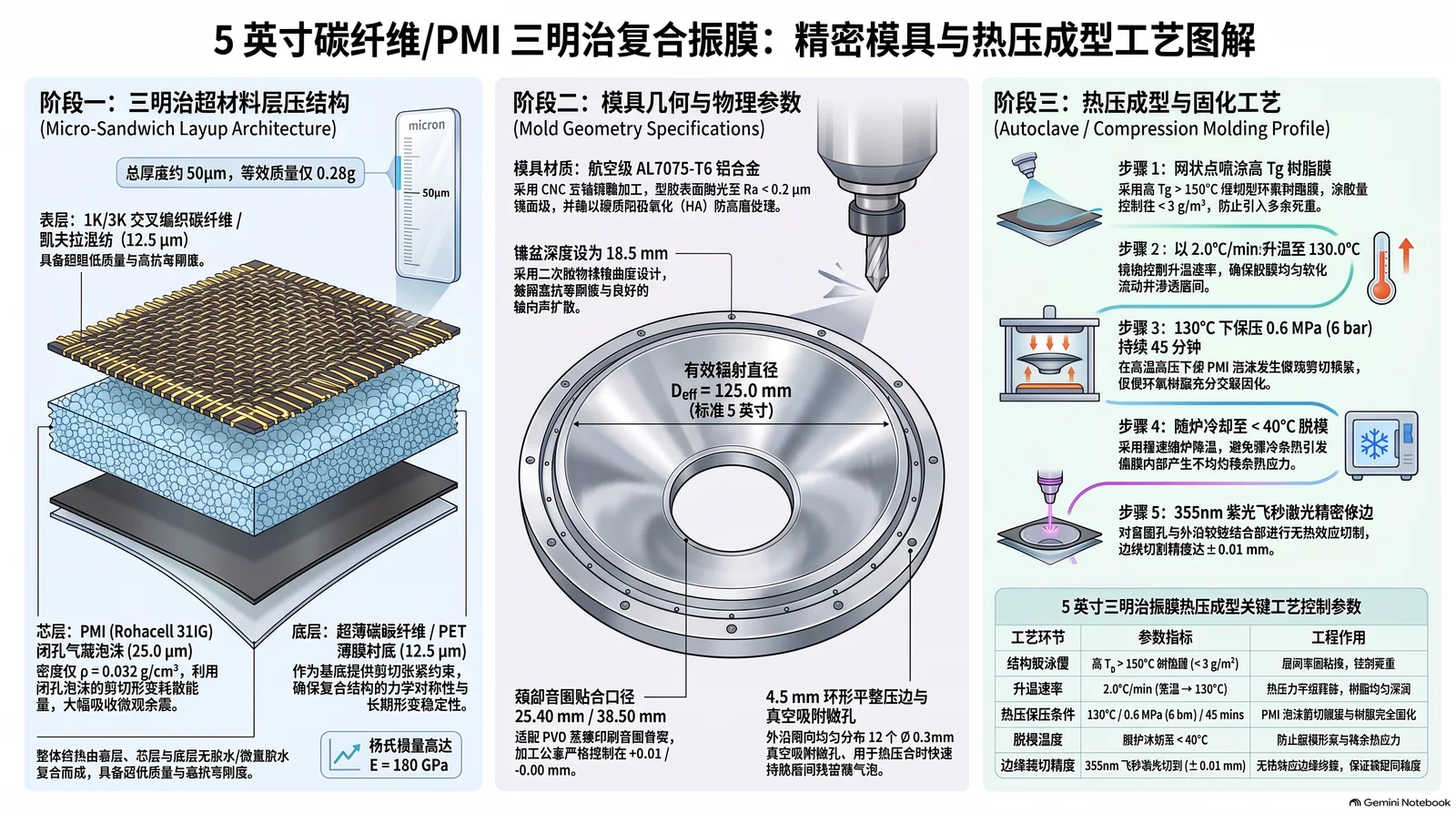
The 5-inch composite diaphragm: holding 50 μm steady
A sandwich structure with an effective mass of just 0.28 g, demanding tooling precision and forming quality approaching semiconductor standards.
- Tooling
- Aerospace-grade AL7075-T6 aluminium, CNC machined to sub-micron precision, cavity surface polished to Ra ≤ 0.2 μm, black chrome plated, with anodised (HA) corrosion protection on the cavity surfaces.
- Structure
- Skin: 1K/3K twill carbon fibre / Kevlar tear-stop (12.5 μm). Core: PMI (Rohacell 311G) closed-cell aerogel foam (25.0 μm, density 0.032 g/cm³). Backing: ultra-thin carbon fibre / PET film (12.5 μm).
- Forming
- High-Tg > 150°C resin film under vacuum hot press (< 3 g/m²) → ramp at 2.0°C/min to 130.0°C and hold for 2 hours → 130°C / 0.6 MPa (6 bar) for 45 minutes → cool slowly below 40°C and demould.
- Trimming
- Edge trimming with a 355 nm violet femtosecond laser, cut accuracy ±0.01 mm, avoiding residual edge stress that would seed micro-cracks and resonance.
- Total thickness
- 50 μm
- Effective mass
- 0.28 g
- Effective radiating diameter
- 125.0 mm
- Young's modulus
- 180 GPa
Magnetic circuit and topology: pushing flux density to 2.2 T
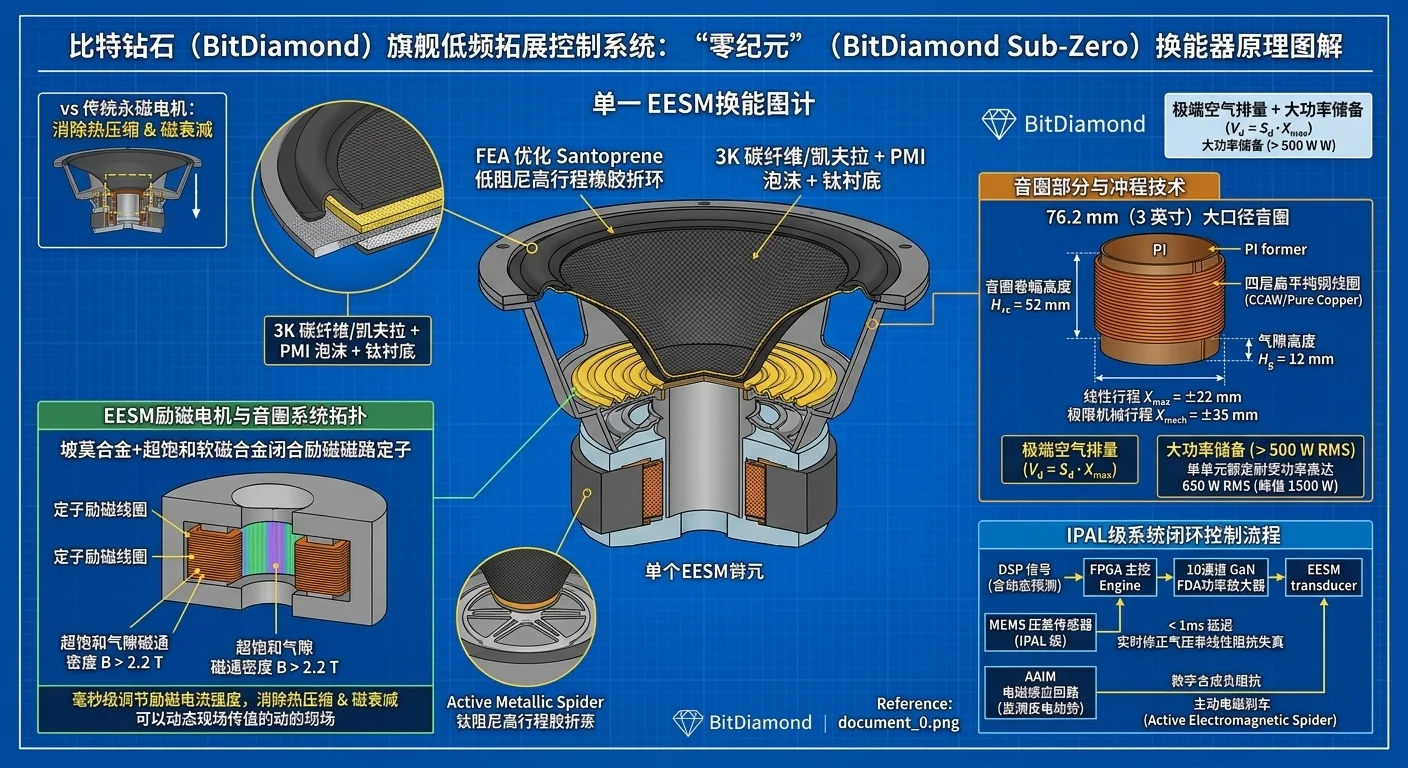
With no permanent magnet the magnetic circuit is self-held by the voice coil — which means the air-gap flux density has to go far beyond what conventional loudspeakers achieve.
- Magnetic material
- Glass alloy plus supersaturated soft-magnetic alloy closed into a magnetic terminal, with a dual-wound stator excitation coil.
- Dynamic excitation
- Sub-second adjustment of excitation current, removing thermal compression and magnetic decay, with on-site field values passed dynamically to the active field.
- Voice coil
- 76.2 mm (3-inch) large-diameter voice coil on a PI Polymer former, four layers of flat copper wire (CCAW / Pure Copper); coil winding height Hc = 52 mm, air-gap height Hg = 12 mm.
- Excursion
- Linear travel Xc = ±22 mm, maximum mechanical travel Xmech = ±35 mm; 650 W RMS per driver, 1500 W peak.
IPAL-grade closed loop: from DSP to the active electromagnetic spider
A transducer does not work open-loop. Actual state is fed back by MEMS piezo sensors, and impedance is actively maintained by digital synthesis.
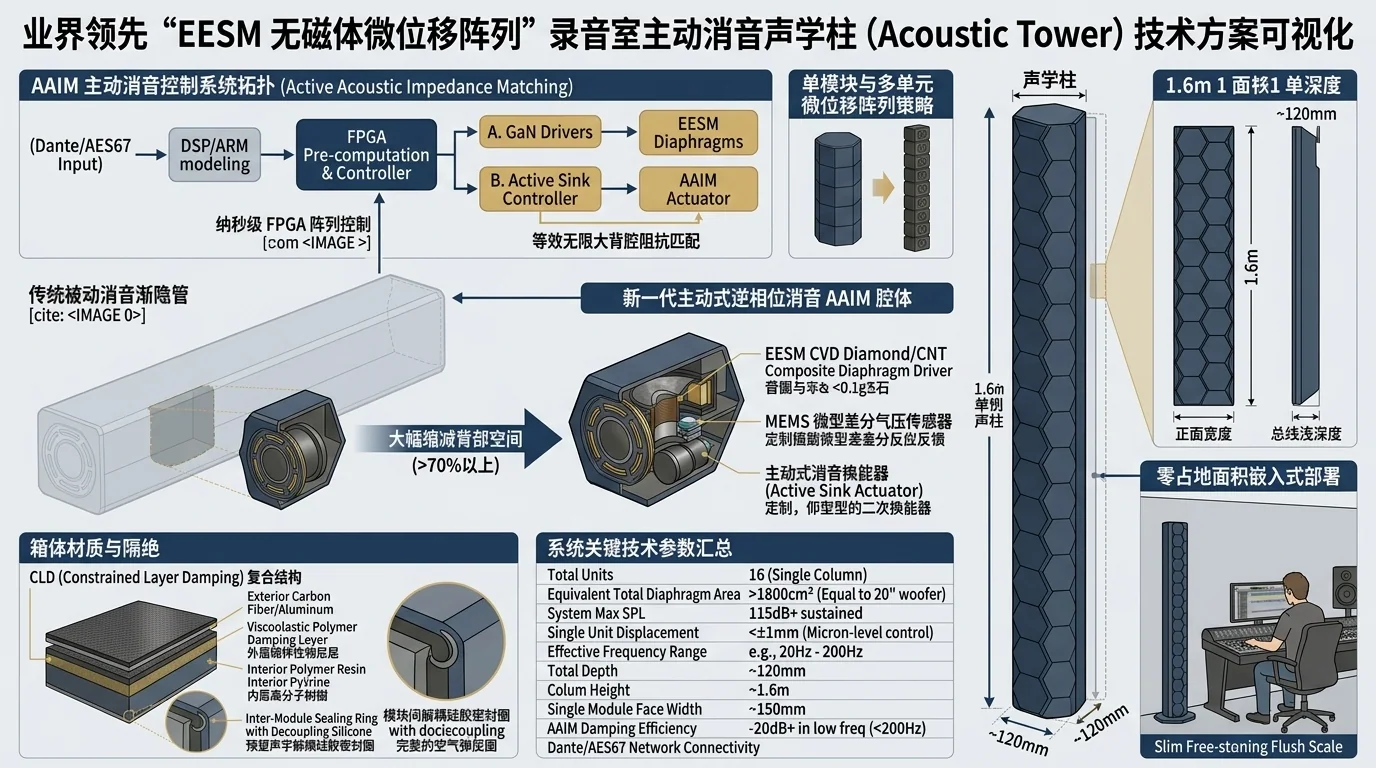
- 01DSP signal (with dynamic prediction)
Dynamic prediction moves the time structure of the programme ahead to the control side, preventing low-frequency overshoot.
- 02FPGA main controller
The closed-loop computation runs on the FPGA, with latency held within milliseconds.
- 0310-channel GaN FDA power amplifier
Fully digital direct drive, with physical noise floor below 0.0005%.
- 04MEMS piezo sensor → AAIM impedance loop
Corrects non-linear air-gap impedance distortion in real time, digitally synthesising the load impedance and bringing the active electromagnetic spider in.