BITDIAMOND
Technology

Distortion is not manufactured
at the amplification stage.

It is already present in the gap of the transducer. All of BitDiamond’s engineering work points at a single goal: take that non-linearity out of the system.

1
EESM
Magnetless Electro-Excited Speaker

Magnetless electro-excited system

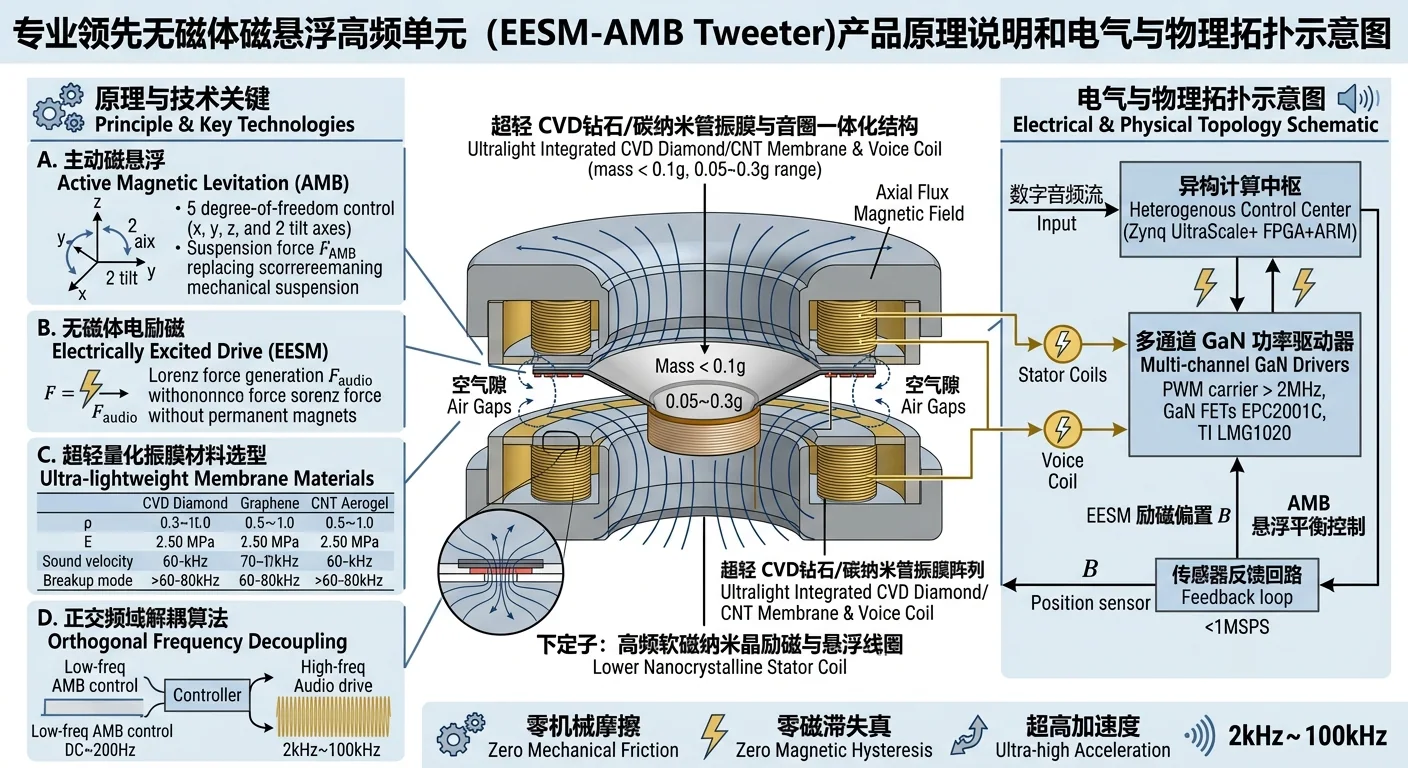
The voice coil is driven directly by the Lorentz force, removing the gap non-linearity between the permanent magnet and the coil so that only a linear electrical-to-magnetic relationship remains between force and input signal.

  • Force linearity
    Strictly proportional to input current
    No permanent-magnet gap involved
  • Magnetic saturation
    None
    Magnetic circuit sustained by the coil itself
  • Transducer topology
    Lorentz-force drive
    No ferrite, no neodymium circuit
EESM-AMB transducer product manual: cutaway of the EESM electromagnetic drive structure and its acoustic topology
2
AMB
Active Magnetic Bearing

Active magnetic bearing

The voice coil floats inside an actively controlled magnetic field, and the suspension gap is compensated in real time by a microsecond-latency feedback loop that removes mechanical friction and non-linearity from the system entirely.

  • Suspension
    Fully active closed loop
    No physical contact wear
  • Position feedback
    Microsecond-latency loop
    Real-time compensation of manufacturing tolerances
  • Damping control
    Fully adjustable
    Prerequisite for AAIM
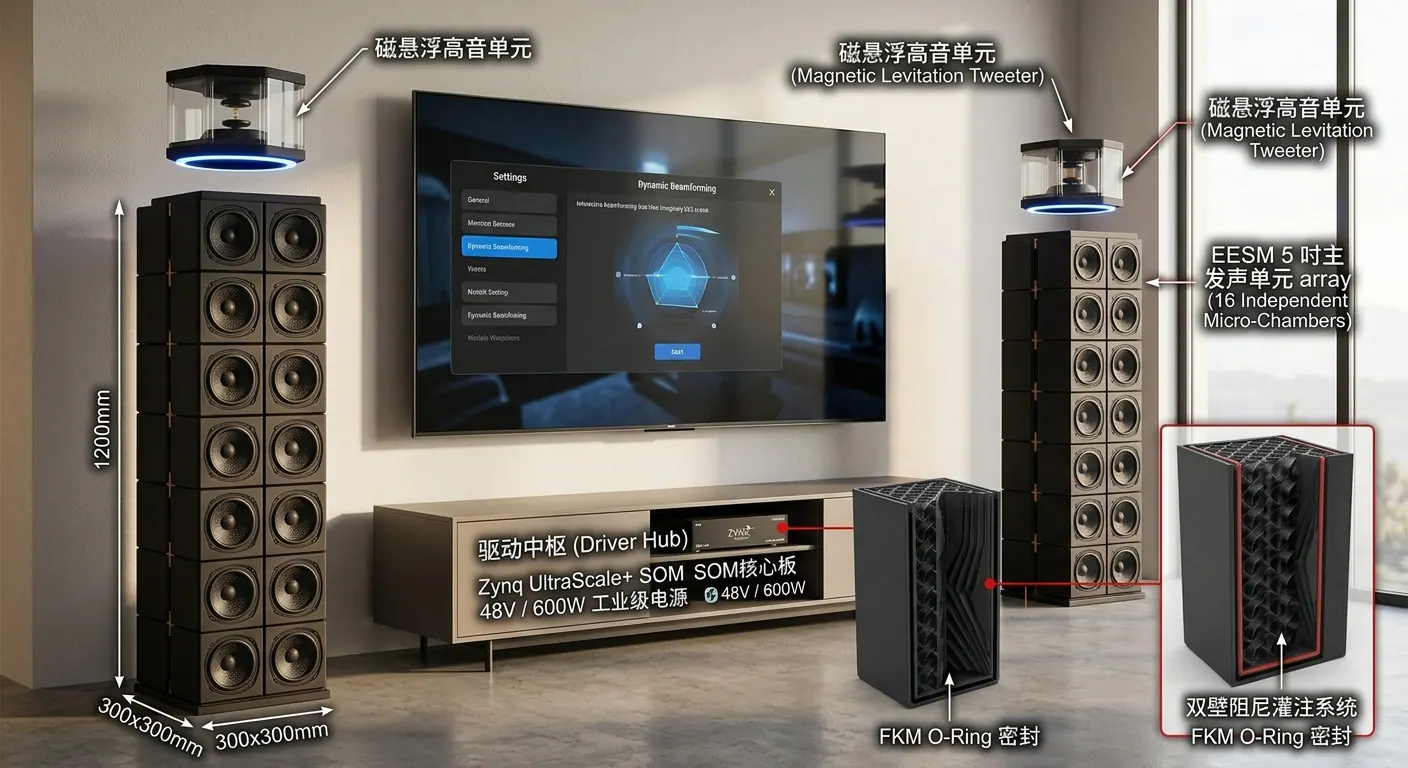
EESM transducer, integrated system and passive thermal design: the active magnetic bearing transducer module
3
AAIM / NIC
Active Acoustic Impulse Management & Network Impedance Control

Active acoustic damping and network impedance control

A negative impedance converter inverts and re-injects the acoustic output of the transducer rear chamber in real time, equivalent to turning a 1.5 L micro-chamber into an infinitely large one.

  • Equivalent cavity
    1.5 L → infinity
    Active cancellation of rear-chamber pressure
  • Vertical field attenuation
    -3 dB/m
    Conventional point source -6 dB/m
  • Total harmonic distortion
    < 0.005%
    Micro-displacement array strategy
Dynamic neural drive and integrated digital circuit logic: the AAIM active acoustic impulse management architecture
Listening validation

Chameleon: making "colouration" a switchable variable

If zero distortion were real, adding a layer of controllable coloration to the system should be easy. That is both a product feature and a reverse validation of ultra-pure-water mode.

Chameleon

Acoustic colouring engine

The same material, switching between two listening models in real time. Ultra-pure-water mode is absolutely flat; warm-valve mode adds +3.5 dB of compensation in the 250 Hz mid-bass harmonic region.

Source

Click any mode to start. Browsers require audio to be started by a user gesture.

20 Hz
20 kHz
FFT window

analyser.fftSize = 256, smoothingTimeConstant = 0.82 — enough to read the shape of the spectrum without keeping the CPU busy.

Colouration filter

A lowshelf BiquadFilter centred at 250 Hz, matching the region of even-order harmonics the ear is most sensitive to.

Gain mapping

Ultra-pure-water mode gain = 0 (absolutely flat); warm-valve mode gain = +3.5 dB.

Materials

Stiffness and internal damping: a division of labour, not a compromise

A conventional diaphragm must choose between stiffness and internal damping. BitDiamond splits the two jobs between two materials, pushes each to its limit, and laminates them into a sandwich.

Skin · CVD diamond

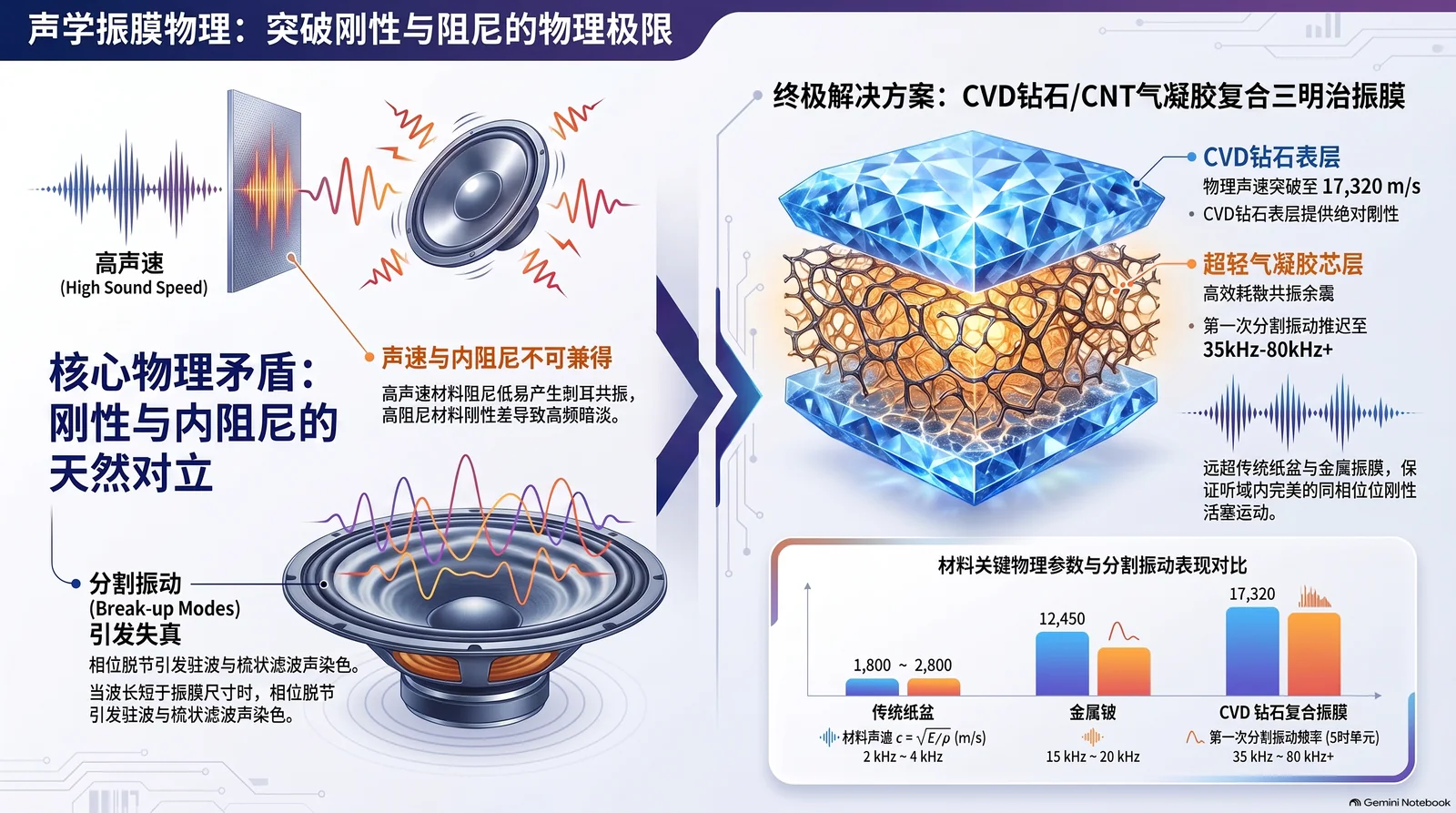
Sound speed 17,320 m/s, Young’s modulus 1,050 GPa. Absolute stiffness pushes the first breakup past 35 kHz.

Core · ultra-light aerogel

One fifth the density of a conventional paper cone, dissipating residual vibration efficiently — a diaphragm phase conventional paper and metal diaphragms cannot reach.

Backing · ultra-thin carbon fibre / PET

Provides the base-support characteristics, keeping the composite mechanically rigid and stable over long service.

Acoustic diaphragm diagram: the physical limits of stiffness and internal damping, and the composite metamaterial answer
Conventional paper cones run at roughly 1,800–2,800 m/s and break up at 2–4 kHz; metal diaphragms reach about 12,450 m/s; CVD / CNT composite metamaterials reach about 17,220 m/s, pushing breakup past 35 kHz.
Validation

Acoustic / structural / optical: solving three coupled fields

A diaphragm is neither purely an acoustic nor a purely structural problem. BitDiamond couples all three in COMSOL, then closes the loop against measurements from physical units.

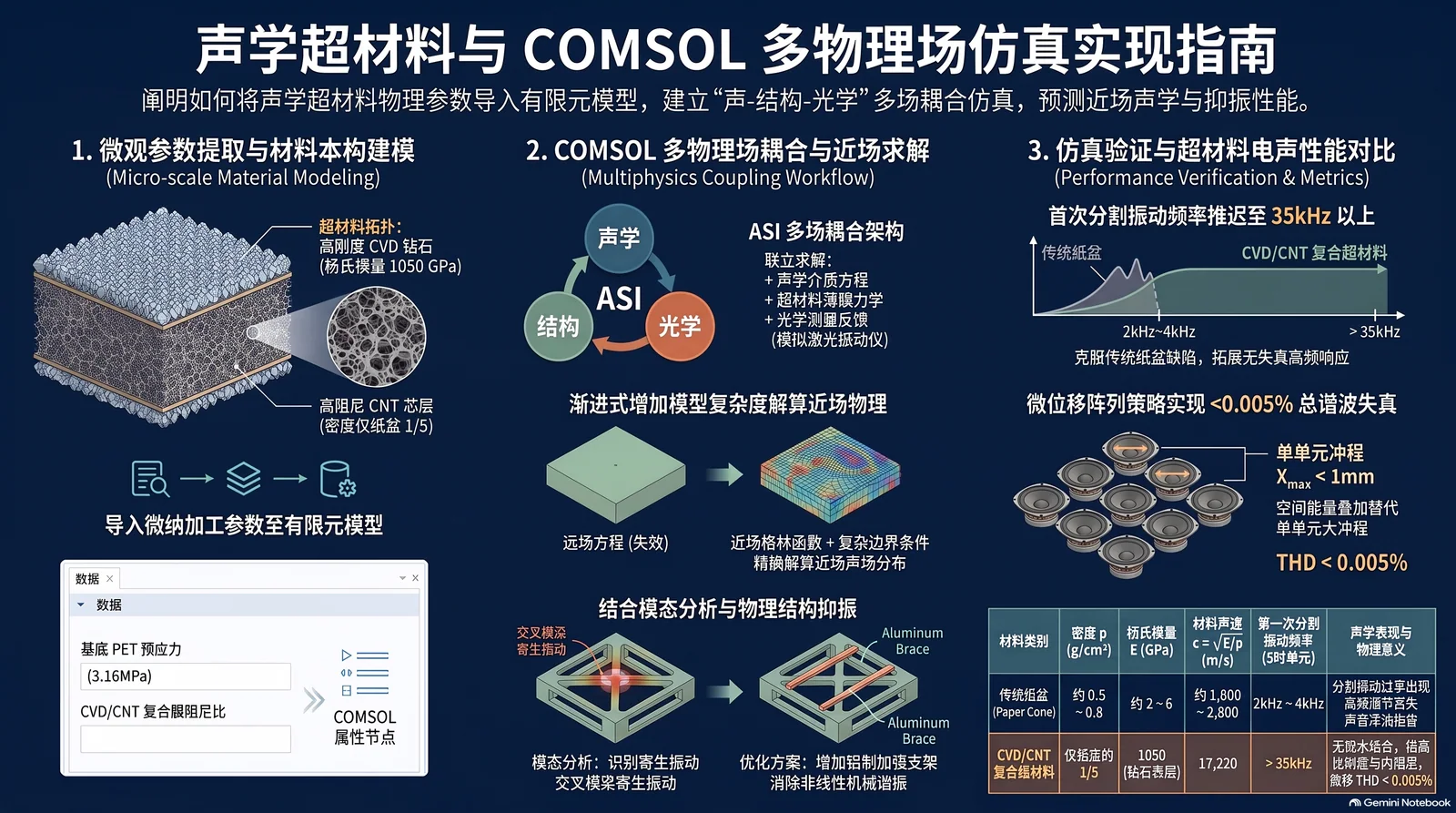
Guide to acoustic metamaterials and COMSOL multi-physics simulation
  1. 01
    Micro/nano parameter extraction

    Import the metamaterial topology (high-stiffness CVD diamond, high-damping CNT core) and PET prestress into the finite-element model.

  2. 02
    Multi-physics coupling

    The ASI architecture solves acoustic interface equations, magnetic pre-computation and optical measurement inversion together, refining boundary conditions on a near-field grid.

  3. 03
    Modal and vibration optimisation

    Modal analysis identifies parasitic vibration; a cross-modal optimisation scheme removes non-linear mechanical resonance with aluminium stiffening brackets.

  4. 04
    Performance validation

    The micro-displacement array strategy reaches THD < 0.005%, with per-driver excursion X_max ≤ 1 mm — spatial energy summation replacing single-driver excursion.